
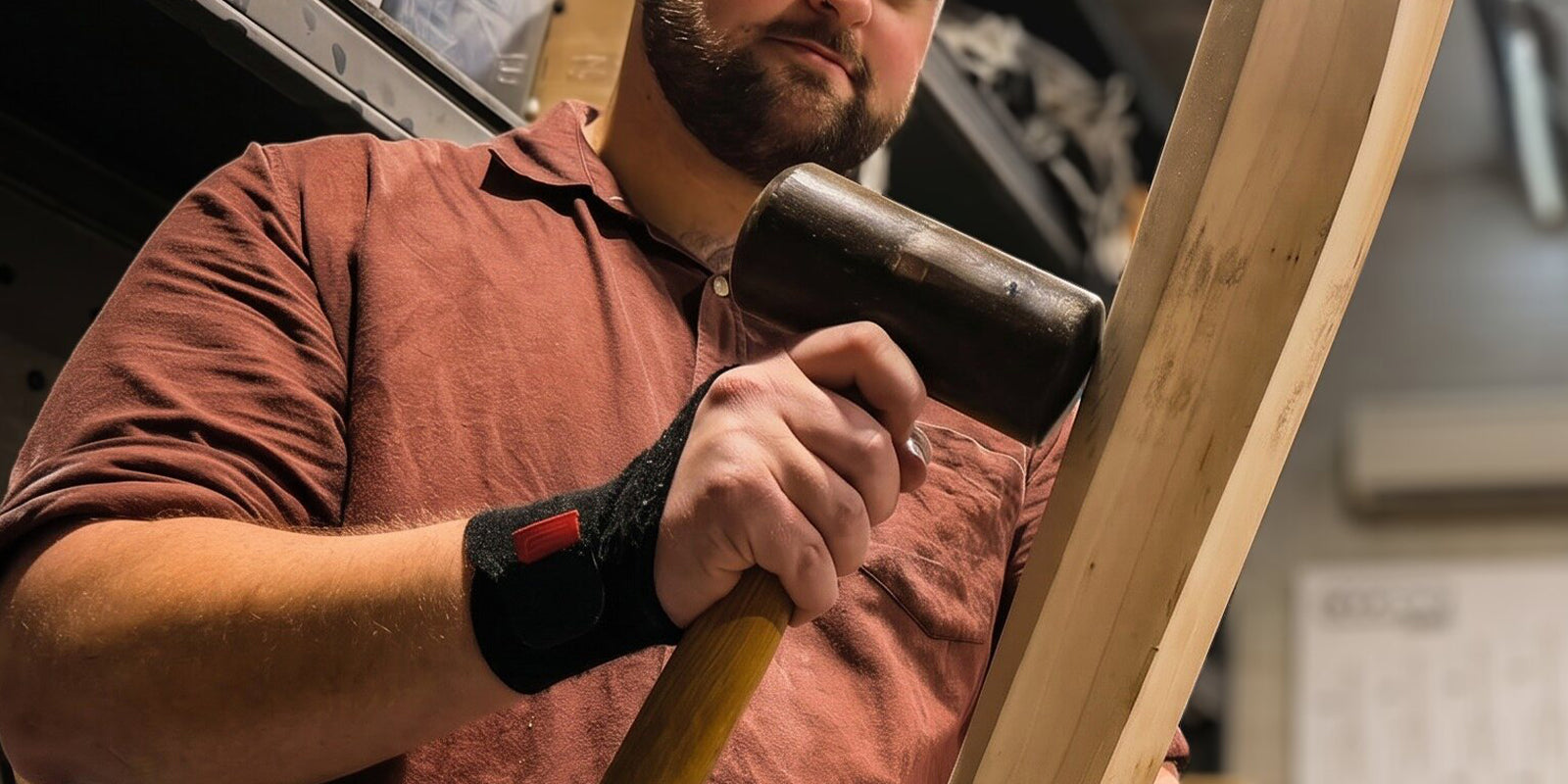
We knock every bat in by hand at Cooper Cricket: oiled first, worked with a specialised heavy mallet, then the edges and toe boned to our standard. People ask why we bother when a machine can do it faster. Here is what is actually happening inside the willow, what the published research shows, and where the science stops and our judgement starts.
What knocking in actually does to willow
Willow is a cellular material. Under a microscope it is millions of tiny tube-like cells, which is exactly why it makes a good cricket bat: those cells compress and spring back.
The foundational study is by Sayers, Koumbarakis and Sobey, published in Sports Engineering in 2005. They knocked bats in for one to four hours and measured the surface hardness. Their finding, in their words, is that the wood cells collapse to form a mesh-like hardened layer which increases in hardness with increase in knock-in duration.
A Cambridge University team led by Tinkler-Davies, Ramage and Shah revisited this in 2022 and measured how deep it goes. The crushed cell layer reached about 123 microns after one hour and about 231 microns after five. Their conclusion matters: the depth of the crushed cells was not large, so knocking in does not affect the global properties of the material, only those at the surface.
So knocking in is a surface treatment. It builds a compacted skin a fraction of a millimetre deep that meets the ball, while the willow underneath stays lively and does the springing.
There is such a thing as too much
This is the part we care about most, and it is measured, not opinion. The Cambridge team tracked hardness against knock-in time and found it climbs to a peak and then falls away again. Their explanation is that the cells near the surface become damaged and lose their hardened properties. Keep going past the optimum and you are not building the protective layer any more, you are wrecking it.
And willow gets there early. They report that peak hardness in willow occurs after about two hours, sooner than the laminated bamboo they were testing.
That is the whole argument for judgement over volume. A bat needs enough work to build its skin and no more, and the right amount is not the same for every bat, because willow varies from cleft to cleft.
The bit nobody in the trade tells you
Knocking in does not make your bat hit harder. Singh and Smith at Washington State University measured bat performance before and after knocking in and found it changed by about a quarter of one percent, slightly downwards. For comparison, in the same tests English willow outperformed Kashmir willow by 0.84 percent.
We think that is worth saying out loud. Knocking in is a durability treatment. You do it so the bat survives the new ball and lasts seasons rather than weeks. Anyone promising that knocking in will add yards to your straight drive is selling something.
Why we oil, and why lightly
We oil the willow before the mallet touches it, and we keep it light.
Being straight about what oil does: raw linseed oil is not a sealant. The US Forest Products Laboratory measured how well finishes exclude moisture and found penetrating oils near the bottom of the scale, with linseed oil offering effectively no vapour barrier after a couple of weeks. So anyone telling you oil locks moisture into your bat is overselling it. What oil does do is condition the surface and help against liquid water and dirt during preparation and play.
What is not in doubt is that over-oiling causes harm, and the manufacturers say so themselves. Gunn and Moore warn that over-oiling adds weight, spoils driving power and may cause rot. A couple of teaspoons over the life of a preparation is plenty. Never stand a bat in oil.
Why we bone the edges and toe
The edges and toe are where bats die. They are the sharpest curves on the blade, so an impact there is concentrated into a smaller area of timber, and the same ball the face shrugs off can chip an unprepared edge. They are also the hardest parts to work well with a mallet.
Boning is the traditional answer: working those areas with a hard, smooth tool under steady pressure to compress and close the surface. We will be honest that this is craft, not laboratory science. There is published work on densifying wood surfaces by compression, but it uses heat and industrial presses, not a hand tool on a bat, so we are not going to dress our bone up in someone else's numbers. What we can tell you is that it is the traditional finish, it targets exactly the areas that fail first, and after years of repairing broken bats we would not send one out without it.
Why we do it by hand
Here is where I will be straight with you again: there is no published study comparing hand knocking with machine knocking. Nobody has run that experiment. In fact both of the studies above used machines to apply their knock-in, because a machine is how you get a repeatable laboratory result. So if anyone tells you the science proves hands beat machines, they have not read the papers.
Our case is not that a machine cannot harden willow. It is about control.
The measured facts we lean on are the ones above: the useful hardening is a couple of hundred microns deep, willow peaks at around two hours, and past the peak the surface cells get damaged and hardness falls. Hitting a bat harder or longer than it needs is not a neutral act. A fixed cycle cannot tell the difference between a dense cleft and a soft one. Hands can.
There is one more thing worth knowing. When you bat, the bat is not held rigid, and researchers at Bath measured what that difference is worth: comparing rigidly clamped, simulator clamped and hand-held impacts on the same bat, the restraint loads were around ten times higher in the clamped rig than in the hand. We would rather prepare a bat closer to the way it will be used.
Net ready, then match ready
Your bat leaves us net ready. You could play a match with it tomorrow and it would hold up. We still recommend a few sessions in the nets first, starting with older balls, and not because the bat is unprepared. Every bat has its own feel, even two built to the same spec, and the nets are where you get to know yours.
Sources
Sayers, A.T., Koumbarakis, M. and Sobey, S. (2005) Surface hardness of a cricket bat after knock-in. Sports Engineering 8(4), 233-240.
Tinkler-Davies, B., Ramage, M.H. and Shah, D.U. (2022) Replacing willow with bamboo in cricket bats. Proceedings of the IMechE Part P 236(4), 255-265.
Singh, H. and Smith, L.V. Describing the Performance of Cricket Bats and Balls. Washington State University Sports Science Laboratory.
Fisher, S., Vogwell, J. and Ansell, M.P. (2006) Measurement of hand loads and the centre of percussion of cricket bats. Proceedings of the IMechE Part L 220(4), 249-258.
Forest Products Laboratory, Wood Handbook, Chapter 15: Finishing of Wood, and Feist, W.C. and Peterson, C. (1987) Protecting Wood from Humidity.
Want your bat prepared properly? Our knock-in service is available for any brand of bat. Drop in to the Northgate workshop or add it to your cart and post your bat to us.
Share:
How our Custom Bat Builder works
Getting your bat ready before the season starts